The gap between knowing and doing is where I work.
I connect what people need to know with what they need to do.
Sometimes that means explaining something complicated so people can make a better decision. Sometimes it's training, research, a clearer process, or a tool that didn't exist yesterday.
I've done it in pharmaceuticals, finance, technology and entertainment. Different industries, same goal: turn complexity into clarity, and clarity into action.
Try a few things while you're here. Explore the work, take an app for a spin, or give FitCheck a job description or project brief. It'll compare the work with my experience, show where I fit, and tell you where I don't.
Four recent builds. Three are public. Go poke at them.
There's no magic prompt. These took hundreds of hours and thousands of decisions, big and small.
I defined the products, designed every detail of the experiences, wrote the specifications, and directed all technical development. Try my apps. LiveCue is easy and useful. The flight simulation is fun and the views of the ship in space are spectacular!
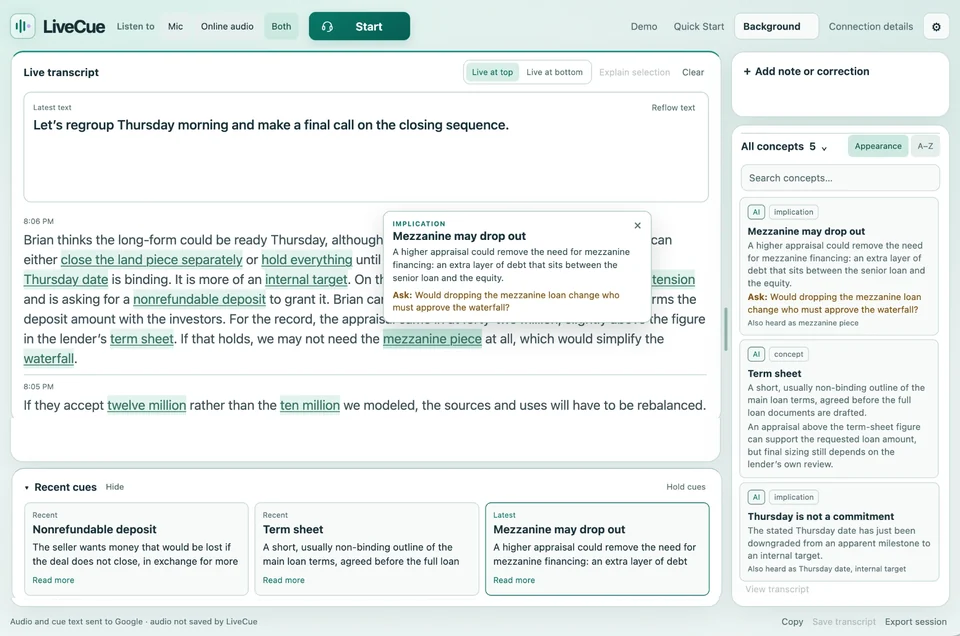
LiveCue
Chrome or EdgeLaptop or phoneAudio not stored
Live transcription that explains unfamiliar names, acronyms and terms as they come up. No pretending you know what pari passu means.
In complicated meetings, technical, financial and legal terms can arrive faster than anyone can look them up. Looking away to research one detail means missing the next three.
I wanted another layer of understanding that worked alongside the conversation, without constantly pulling my attention away.
I defined the product and the interface, directed the AI-assisted development, tested it in real meetings, and used independent reviews to challenge each release. The first working version went from concept to reality in two weeks.
The demo needs no key. Live use takes your own Gemini key, kept in your browser.
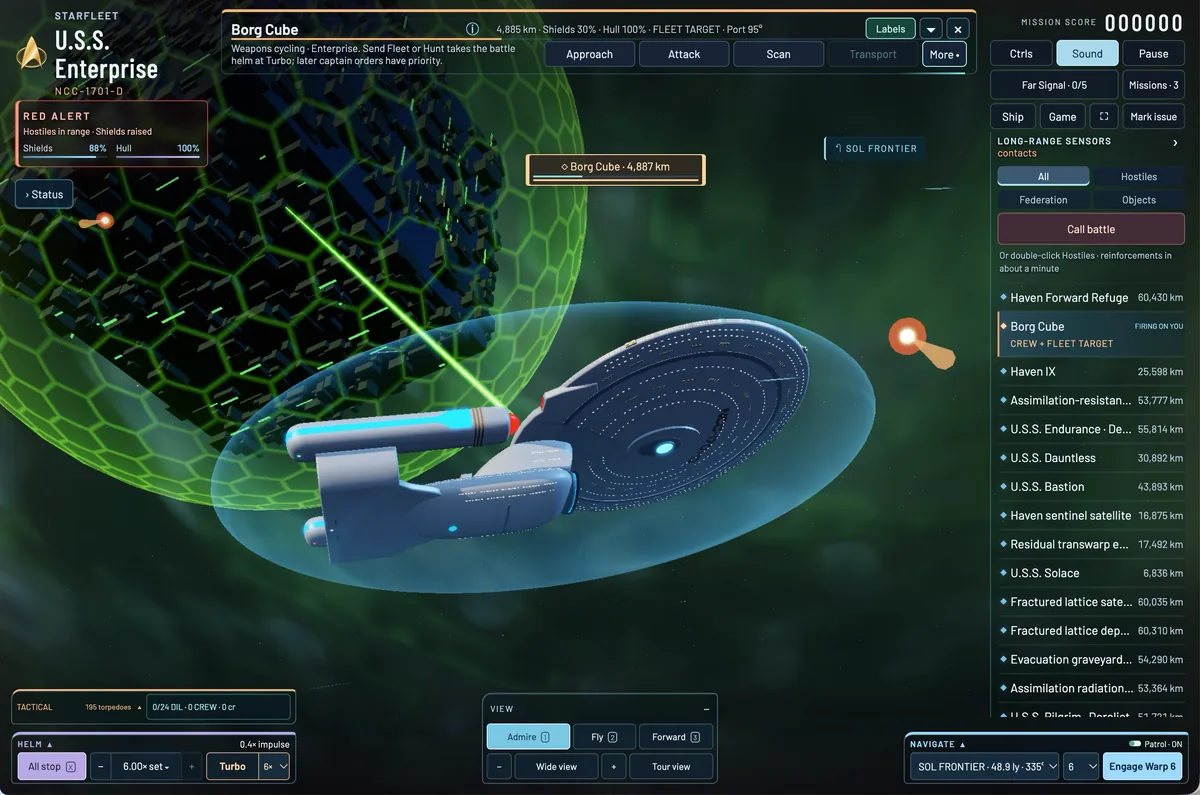
Enterprise-D Flight Deck
Any browserLaptop or phoneBuild 110
A starship flight and tactical simulator. Fly the ship yourself, or let the crew take the helm, Captain.
I wanted to play an old Star Trek game on my Mac. The surviving Windows version wasn't worth wrestling into submission, and the online alternatives weren't what I wanted.
I'm not much of a gamer. I wanted to explore the Enterprise, admire the ship, fly it myself, or hand the helm to the crew.
On September 10, 2026, I decided to build my own.
How
The game became the experiment. Could someone who doesn't write code direct AI to build something truly complex, then test it, debug it from its own flight logs, and keep piling on features without losing control?
I set the direction and wrote the specs. I played every build and read the telemetry, and shaped the ship's sound in a custom Audio Lab I built for it. ChatGPT and Codex wrote the code. Claude and Gemini reviewed each build independently before release. Saucer separation, fleet behavior, docking, mobile controls and far too many edge cases came out of that loop.
Turns out, yes. Build 110.
Unofficial fan project, not affiliated with Paramount.
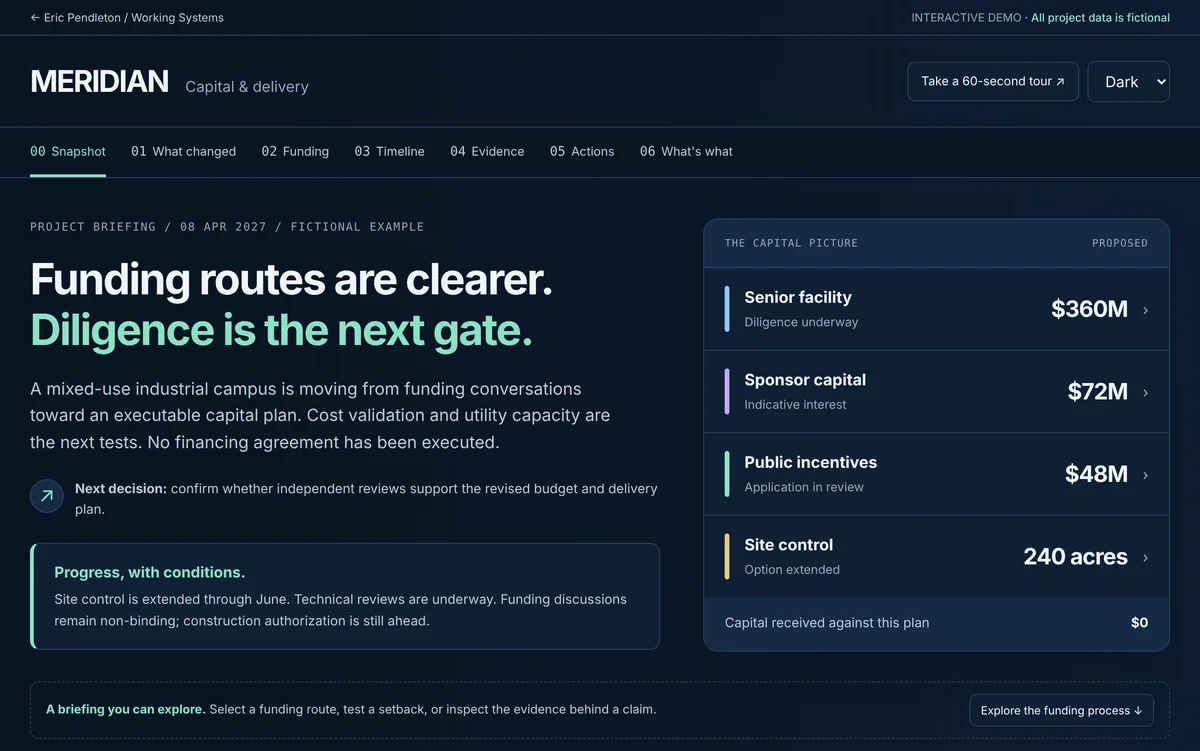
Infrastructure Project Briefing Interactive demo
Complex projects throw off meetings, documents, decisions, changing assumptions and open questions.
I designed an AI-assisted workflow that turns recordings and source documents into one coherent project briefing, which I execute, check, and publish internally to my partners each week.
Fictionalized demonstration based on a real, ongoing project.
Constantly hunting for pieces of information is not a workflow. AI platforms are useful collaborators; my problem was scattered information across conversations, email and documents.
So I built a shared project record using common tools: a Drive folder, a sheet and a protocol document. The AI systems work from the same decisions, action items and reference documents instead of reconstructing everything from memory. Less searching, more time doing what comes next.
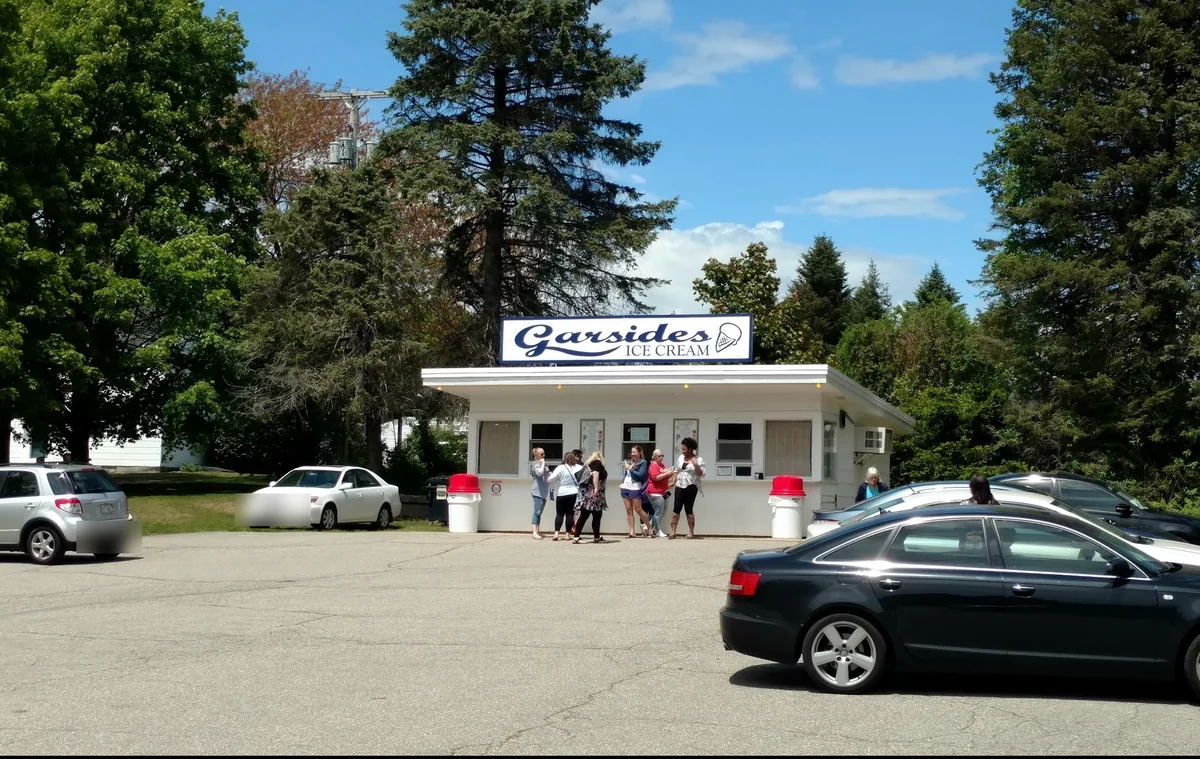
02Garside's Ice Cream, Saco, Maine
The ice cream stand that became a business laboratory
OperationsProduct developmentHiringTrainingEmployee manualPricingVendor negotiationsMarket research
My family owned Garside's, which has made its own ice cream on Ferry Road since 1956, for decades. I developed the recipes, trained the employees, managed operations, set the prices and did just about everything else, including mowing the lawn.
When customer traffic began declining, I wanted to understand why. So I made the business the subject of my master's research: customer surveys, interviews, focus groups, vendor pricing, historical sales and weather data. The findings challenged some obvious explanations and exposed problems we could actually fix.
The resulting plan focused on consistency, product variety, customer retention and training. One immediate change, renegotiating our dairy pricing, cut a key ingredient from $26 to $16 a bag and saved more than $7,000 a season. It was a practical lesson in separating what a business can control from what it can't.
I didn't just sling ice cream. But I absolutely slung ice cream.
The early years were growth. When my family bought the stand, the summer I finished high school, it had a loyal following, thirteen flavors and unpredictable hours. We set regular hours, upgraded the cream and expanded the flavors; revenue rose 800% over the next two seasons. I wrote about a hundred recipes, starting with Mint Chocolate Chip the first summer, and thirteen flavors became forty. Much of it I did on weekends from Boston. We sold the stand in 2018.
The decline came much later. The stand records every order, every day, in a notebook, and by the 2000s decades of those records showed customer traffic falling. The market around us was changing, too: tourism along the Maine coast had softened, the country was counting cholesterol, and fast-food chains were selling inexpensive sundaes.
To understand what was driving the decline and where we could make a difference, I made Garside's the subject of my master's capstone: two surveys, 314 respondents; fourteen customer interviews and focus groups; a vendor-pricing review; state weather data; and a season observing the business at the serving windows. A third survey followed in 2017.
The historical data didn't support weather as the principal explanation: four of the best ice cream summers in the record produced no bump. Customers didn't point to the economy either: 87% said it hadn't changed how often they came.
Customers didn't point to the product: 95% rated Garside's equal to or better than Häagen-Dazs and Ben & Jerry's, and 58% said better.
The research pointed to four likely causes. Three belonged to the market: Maine's tourism slump after 2001, a public eating less ice cream for its arteries, and a cheaper sundae at the drive-through. The fourth was ours: hours trimmed at both ends, and running out of basics like sugar cones. Once a customer is lost, getting them back is the hard part.
So the plan worked on what we controlled: consistency and promotion. Fifteen points, most of them cheap: new flavors every week (62% asked for them), a flavor contest (winner: Mosquito Ripple), weekday specials, gift certificates, the old hours restored, and a rewritten training manual.
The first move paid before the paper was finished. We asked the dairy for volume pricing. The base mix went from $26 a bag to $16 overnight, saving over $7,000 a season.
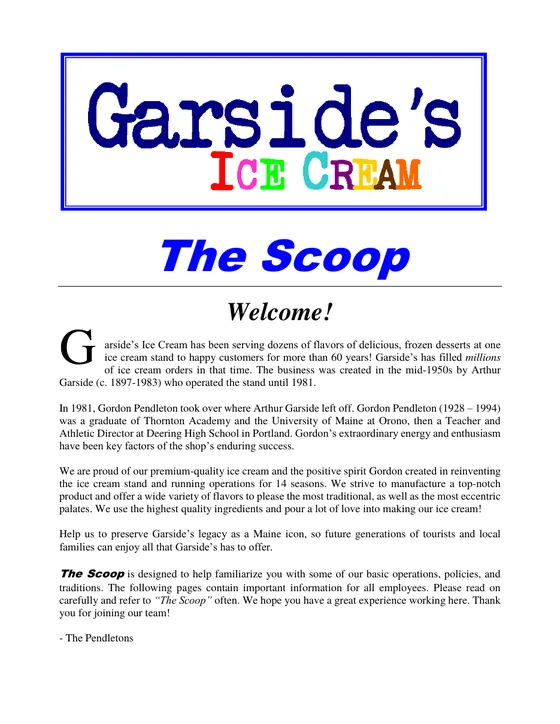
The Scoop
Employee manual · 10 pages · PDF · 0.9 MB
A good operating plan isn't worth much if the next employee doesn't know how to carry it out. Point five of the plan: I rewrote our employee manual to make procedures, expectations and customer-service standards clear from day one, from opening and closing checklists to the "arc" scooping technique and what to do about a Grumpster. It became the foundation for each season's training. Training meant showing them the work, letting them practice, and checking that they could carry it out. This is the 2015 edition.
Before we build the training, what's getting in the way?
Before building a course, I look at what people need to do, what gets in their way, and what improvement would look like.
A customer-service manager asks for a course: "Onboarding is taking too long." Here is what three new hires said. Select what you're hearing; more than one can be true.
Each points somewhere different. Training fits one of them.
Not everyone needs the same depth. My 2018 paper sorts each role's needs into three rings: what you know about, what you're trained on, and what you're qualified on, meaning shown you can do it.
Know about
The exception policy and why it exists; who can approve an exception.
Be trained on
Finding the current rule; the most common exceptions.
Be qualified on
A standard request, start to finish, unaided; spotting an exception and routing it.
Know about
How quality reviews are scored.
Be trained on
Everything the agents are trained on; coaching from review findings.
Be qualified on
Approving or refusing an exception and recording why. In this fictional team, that authority belongs to the lead.
Know about
What new hires have covered, and when.
Be trained on
The exception policy in full; the scoring guide.
Be qualified on
Scoring a case the way the other reviewers would; telling a training gap from a process gap.
No numbers here: they would be invented. What matters is which question each measure can answer.
Completion
Tells you who finished the training.
Doesn't tell you whether anyone can do the work.
Measured when training ends.
Demonstrated capability
Tells you whether each person can do the task to the standard, observed and signed off.
Doesn't tell you whether the work improves once they're on their own.
Measured before they work unsupervised.
Work results
Tells you whether onboarding got faster and cases came out right.
Doesn't tell you that training caused it.
Measured once people have settled into real work.
Other changes can explain results too: new software, staffing, a policy update. I write them down before anyone credits the course.
Behind the approach
Learning for Competence, white paper, February 2018, sole author. The performance model and the three rings. It already argued against deviation rates as a measure of training; the rest of this panel is how I'd put it today.
Two PDFs, an article and a cartoon walk into a bar…
What do they have in common? Complicated material and different audiences. (And in the cartoon, there’s a cat!)
West Side Kitchen, Paris
Whiteboard video · YouTube
A whiteboard video for a longtime friend's American-style sandwich café and caterer in Paris's 17th arrondissement, which he ran for 25 years. Friendly sandwiches. Delivered.
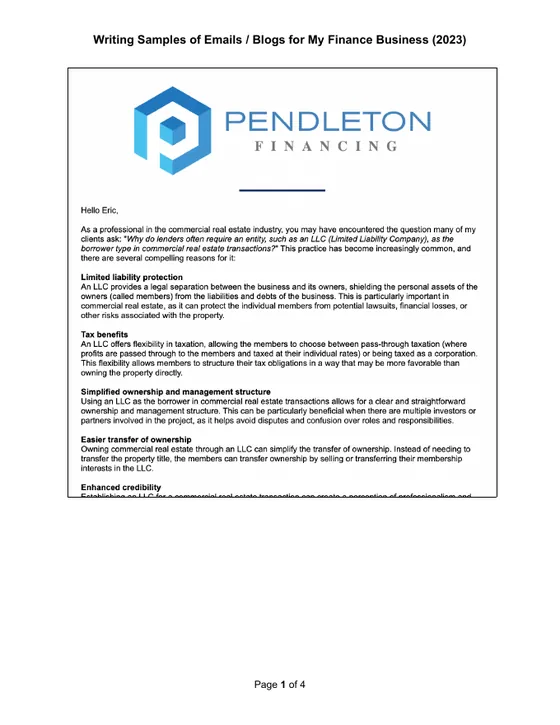
Four client pieces written for Pendleton Financing, my commercial-lending brokerage: why lenders want an LLC as the borrower, adaptive reuse, getting started in long-term rentals, and 1031 exchanges. Plain English for people about to sign something.
5 Steps to Unlocking the Value in Unstructured Big Data
Article · Quirk's Media · April 2017
Five practical things to do with the text nobody reads: survey comments, call transcripts, support tickets, social posts. Written for marketing researchers at a point when "text analytics" was a vendor promise more than a practice. Still holds up: the lessons are business strategy and operating habits, not the tools.
AI made me dramatically faster. It also gave me more places to lose the thread.
So every project runs on four habits from years of regulated work: define the requirements, review independently, test the results, and keep a traceable record. Choose one to see it applied to a real problem.
Case · LiveCue · September 30, 2026
The 56 words that disappeared.
In a session I ran to test LiveCue, a long passage appeared as live text. When I pressed Stop, the speech service's final transcript came back shorter, with earlier wording changed, and the app threw away the last 56 words it had already shown. The repair keeps them, marked as unconfirmed.
01 · Spec before build
Start with the problem, the audience and a clear definition of success. The specification can evolve, but the purpose shouldn't get lost.
The rule: never discard words the listener has already seen. Keep the speech service's final text exactly as delivered, and show anything it dropped separately, marked unconfirmed, because a live draft is not proof of accuracy.
02 · Independent review
A different model reviews the work. No AI grades its own homework.
A second AI model reviewed the code by reading it and judged that dropped draft text was preserved. It could not run the tests or see a real session. A real session showed what reading alone missed: when the final text also rewords earlier phrases, the app's matching fails and the ending is thrown away.
03 · Proof before release
Tested in real use, checked against logs and sources. A claim without proof doesn't ship.
The recorded text updates from that session were replayed against the app, and the failure reproduced. After the repair, the same replay kept all 267 characters of the dropped ending, 56 words, in the transcript and the export. That is a replay of recorded updates, not a new live session, and nothing can recover words the service never sent.
04 · One current version
One current source of truth. Changes are traceable; superseded decisions are identified rather than silently rewritten.
The service's final text stays exactly as delivered; the dropped ending follows it, labelled as an unconfirmed draft. The repair is recorded with its test, dated September 30, and the same safeguard is in the current release, 1.7.0-dev.31, checked October 21.
Reenactment · sample wording
On screen while talking
Thanks, everyone. Before we wrap, the launch moves to the fourteenth. The venue holds three hundred, and invitations go out Friday. Replies are due by the first.
Final text from the speech service
Thanks, everybody. Before we wrap, the launch moves to the fourteenth.
Saved transcript
Thanks, everybody. Before we wrap, the launch moves to the fourteenth.
The last two sentences, already shown on screen, are gone.
unconfirmed draft · provider final omitted later draft textThe venue holds three hundred, and invitations go out Friday. Replies are due by the first.
Evidence and limits
From the LiveCue repair report of September 30, 2026, on a desktop Chrome session of release candidate 5. Last live draft: 1,323 characters. Final from the speech service: 877 characters, with earlier wording changed. The distinct ending it omitted: 267 characters, 56 words. After the repair, replaying the recorded sequence kept all 267 in the visible transcript and the export.
Not established: that recognition is complete or accurate, that every provider path behaves the same, or a fresh live test. The kept words are what the service sent as provisional text; their accuracy is not confirmed. The October 21 check confirms the safeguard's code is in the deployed release, not its behavior in a new session. The wording in the reenactment is invented.
AI can rewrite 500 pages in an afternoon. Checking page 340 is still a person’s job.
NCC-1701-A
06About
Where the discipline comes from
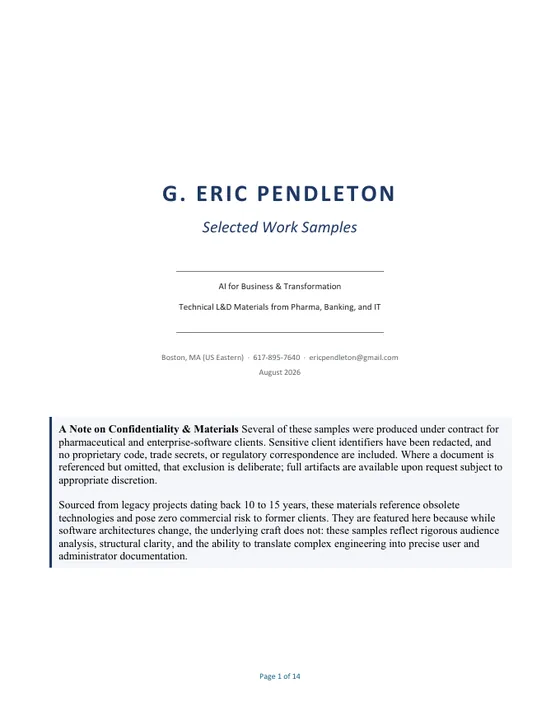
I've spent much of my career helping people understand complicated things well enough to act on them: learning programs, technical and business translation, knowledge systems, operations, and the documents behind consequential decisions.
The question is always the same: what do people need to understand, what are they trying to do, and what's in the way? The questions I ask before writing a word are the actual work. AI now lets me go past the explanation and build the tool.
The technology is new. The judgment behind it isn't.
NowLunchbox Labs, an animation studio: partner and executive producer. Development, production, business materials and complex decisions, including a human-governed, multi-model AI review of contracts, financial records and investor materials. Gaia Eco Developments, regenerative infrastructure: equity partner. Investor narratives, executive briefings, and the material that connects funding strategy with execution.
BeforeCorporate training and quality systems at Takeda, Alexion, Shire and Citizens Bank: an enterprise train-the-trainer program, competency-based GxP training with role-based qualification, and a 500-page knowledge system for a lending platform used by about 2,000 people. Training, documentation and communications in pharmaceuticals, banking, technology and government.
FranceSix years: teaching, then corporate communications and company-wide English training at bioMérieux in Lyon. Fluent French. Conversational Spanish. Boston, remote-first.
M.S., Business Management, Emmanuel College · M.A., French Language and Literature, Washington University in St. Louis, Teaching Fellowship · B.A., French Language and Literature, Colby College, Psychology minor
Born in Waterville, and raised in Saco, Maine. Only child. My father taught history and directed athletics at Deering High School in Portland.
The summer I finished high school, my family bought Garside's, a seasonal ice cream stand on the Saco River. I made the ice cream, wrote the recipes, hired and trained the crews, painted the building and mowed the grass. I kept doing that on weekends from Boston for years, to help my mother. She passed and I sold it in 2018.
Thornton Academy, Phillips Exeter, then Colby, where I studied French and sang tenor with the Colby 8. Then France: two years in Avignon running a school's term abroad, which I rebuilt from scratch; summers directing immersion programs for Dartmouth's Rassias program and Washington University; a stretch in Caen, Normandy.
Grad school in St. Louis, where I taught French at the Alliance Française and performed in rock musicals on the side. A biomedical-diagnostics company hired me to teach its engineers French, translate all kinds of business and technical materials, then moved me to its global headquarters in Lyon for corporate communications and company-wide English training. Six years in France all told. People still take me for French.
Boston since. Software, banking, state government, pharma, in that order, mostly teaching people to use complicated systems and writing the documents that keep regulated work honest, and compliant. A few years running my own commercial-lending brokerage. Now a partner and executive producer at an animation studio with a feature in production, and an equity partner in an advanced infrastructure venture.
Also: fourth of sixteen finalists on The Next MJ Millionaire, an Amazon Prime business-competition reality show, pitching an ice cream concept called “chill.” SAG-AFTRA eligible. Jesus in Jesus Christ Superstar at Exeter. Formally practiced and always terrible at: tennis, piano, skiing, and windsurfing. Still a damn good singer. Maine accent available on request.
07Contact
Have something complicated that needs to work better?
I help organizations turn complex information into clear communication, effective learning, better decisions and practical tools. Available for fractional, contract and project work in executive communications, learning and enablement, research, technical writing, English–French translation, and AI-assisted workflows.